Australian Merchant Navy
The civilian mariners who kept Australia fed, supplied and connected to the world.
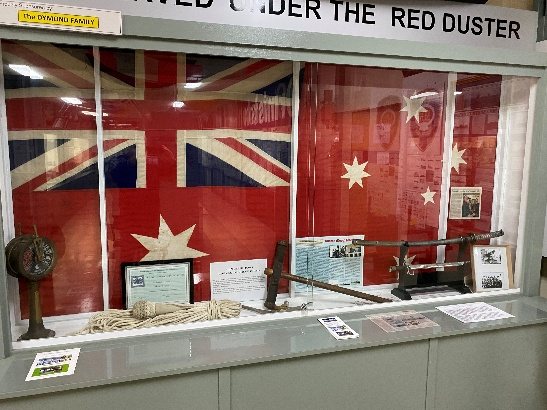
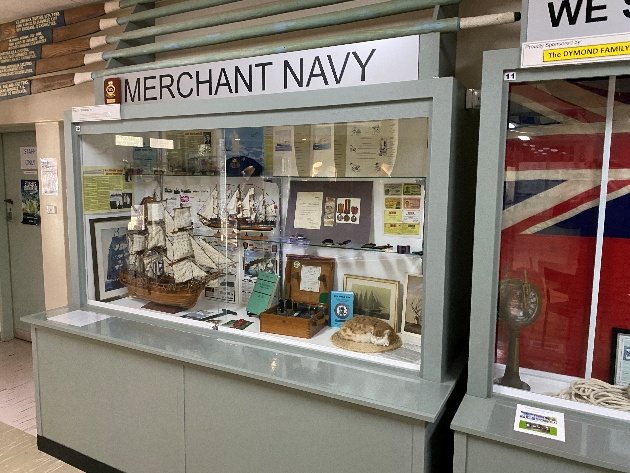
The Victorian Maritime Centre dedicates a substantial part of its exhibition space to the Australian Merchant Navy (AMN). While military history often dominates naval museums, this dedicated display ensures the profound wartime sacrifices and economic contributions of Australia's civilian mariners are properly honoured.
A key focus of the display is the critical role merchant seafarers played during major global conflicts, particularly World War II. Known as the "Fourth Arm of Defence", these civilian crews operated supply lines under constant threat of enemy submarines, mines and surface raiders. The museum illustrates this treacherous history through historic photographs, logbooks and rare artefacts.
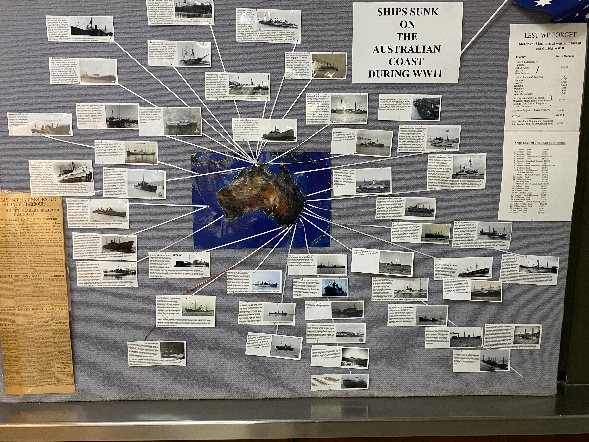
A standout exhibit is titled "Merchant Navy War on the Australian Coast". It identifies the merchant navy ships lost around the Australian coast. Most visitors are shocked to see how many ships were lost on their nation's doorstep.
The display also celebrates the broader maritime history of local shipping, highlighting the civilian vessels that shaped the region's commercial identity. A prominent feature is the history of the iconic MV Wyuna, a 1953 pilot cutter built in Scotland for the Port Phillip Sea Pilots. For 26 years this diesel-electric vessel braved the hazardous waters of Bass Strait, serving as a floating base to deploy pilots who safely guided global cargo vessels through "The Rip" into Port Phillip Bay.
Through highly detailed scale models of cargo vessels, merchant uniforms and personal accounts, the display captures the daily lives, engineering challenges and bravery of these seafarers. It is run entirely by knowledgeable volunteers from the Western Port Oberon Association, and it preserves the legacy of the civilian fleet that kept Australia fed, supplied and connected to the world during its darkest hours.
In the museum
A short history of the Australian Merchant Navy
The Australian Merchant Navy comprises the civilian mariners and commercial vessels registered in Australia that keep the nation's supply chains alive during peace and war. Because Australia is an island continent dependent on maritime trade, these crews have historically formed a vital fourth arm of the nation's defence infrastructure. Despite suffering disproportionately high casualty rates during the major conflicts of the 20th century, their contributions were historically overlooked compared to the armed services.
Early foundations and colonial trade
Before the federation of Australia in 1901, merchant shipping was organised on a colony-by-colony basis. Early maritime activity focused on sealing, whaling, and moving essential agricultural goods between distant coastal settlements. Because overland transport across the vast, rugged Australian interior was extremely difficult, coastal shipping became the primary economic pipeline linking colonies like New South Wales, Victoria, and South Australia.
The foundation of organised representation for the merchant workforce began with local maritime unions, most notably the Seamen's Union of Australia in 1872. By the late 19th century, major industrial conglomerates like the Broken Hill Proprietary Company (BHP) began operating their own dedicated cargo fleets to transport iron ore and raw materials, making merchant shipping a critical pillar of Australian industrialisation.
The First World War (1914 to 1918)
Upon the outbreak of World War I, the Australian government immediately requisitioned dozens of commercial passenger and cargo vessels for military service. These ships were rapidly refitted to serve as troop transports, hospital ships, and supply carriers.
Troop transport. Merchant ships transported the first waves of the Australian Imperial Force (AIF) to Egypt and later to the Gallipoli campaign.
The logistical lifeline. Throughout the war, civilian crews ran the gauntlet of German U-boats in the Atlantic and Mediterranean to transport Australian wool, wheat, and minerals to Great Britain and her allies.
Lack of recognition. Because merchant mariners were technically civilians under commercial contracts, their losses were poorly documented compared to the military. Many who died were logged on the Commonwealth War Graves Commission records but omitted from standard military rolls.
The Second World War (1939 to 1945)
World War II brought the conflict directly to Australia's doorstep, transforming domestic sea lanes into active combat zones. Following the entry of Imperial Japan into the war in late 1941, Australian coastal trade became a prime target. To defend themselves, cargo vessels were modified into Defensively Equipped Merchant Ships (DEMS). They were fitted with stern-mounted guns and anti-aircraft weaponry, and manned by a mix of civilian mariners and Royal Australian Navy (RAN) personnel.
The U-boat and submarine threat. Between 1940 and 1944, enemy mines and Japanese or German submarines sank approximately 30 merchant ships in Australian waters, resulting in roughly 654 deaths.
The Centaur tragedy. The most infamous loss occurred on 14 May 1943, when the Australian Hospital Ship AHS Centaur, clearly marked with illuminated red crosses, was torpedoed by a Japanese submarine off Queensland, killing 268 people, including 26 merchant crew members.
Post-war era and modern legacy
For decades after the World Wars, Australian merchant mariners fought a long bureaucratic battle for official recognition. Because they were civilians, survivors were initially denied access to military pensions, war service loans, and repatriation benefits. This inequality was finally addressed through federal inquiries and legislative amendments in the late 20th century, which granted merchant veterans the same benefits as regular service personnel.
During the war, the Australian government and Allied forces requisitioned dozens of commercial vessels for wartime service, converting them into troopships, armed merchant cruisers and hospital ships. After 1945 the fleet went through a period of post-war recovery, eventual decline, and modern-day commemoration.
In the decades following the mid-20th century, the Australian-flagged merchant fleet suffered a severe, permanent decline. Today, Australia has largely abandoned its domestic merchant fleet. Opinions are mixed on the exact cause. Some argue that union demands for higher wages and strict conditions priced Australian shipping out of the market. Other historians and industry insiders point to government deregulatory policies and tax structures that disadvantaged local shipping, leading to a reliance on cheaper, foreign-flagged "flags of convenience" vessels.
From a robust ecosystem of over 60 domestic shipping companies in the mid-1900s, the Australian-flagged coastal trading fleet has dwindled to roughly 45 ships, resulting in a critical shortage of trained Australian mariners, engineers, and port managers.
Today, the historical sacrifices of these mariners are formally honoured every year on Merchant Navy Day (3 September), ensuring their legacy as the unsung providers of Australia's wartime survival is preserved.